Translate

Showing posts with label activism. Show all posts

Wednesday, July 30, 2014

Port Townsend, WA vs Arhata Osho

Port Townsend, WA, a calm liberal hipster art area's municipal government is trying to regulate Arhata Osho, a 64 year old activist & friendly-hippy-looking with long hair & a ty-dye shirt's free speech. "Free Speech has been stolen" his sign reads. His protest-sign-cart has a LGBTQ-rainbow American flag, and many protest signs with messages ranging from his story of his court case, why free speech is important, anti-discrimination, & anti-religion("religion is all a myth"). At his cart you can donate money to him or sign up for his email list to receive his political writings. He's not yelling or soliciting, and his cart is only the size of about a shopping cart excluding the tall rainbow flag. It may be somewhat of an eyesore to some, but it's not causing any noise pollution and isn't blocking the walkway. “If they pass this, they are going to have to cart me away" he said in regards to the regulations being imposed. A local waitress commented saying "Port Townsend is always being difficult." Shocking to Arhata was that "this is happening in a state that legalized marijuana & has passed leading laws in gay rights. I might have thought this would happen to me when in California, but not here." Osho started on Venice Beach.

Follow Arhata at his blog:


Sunday, November 17, 2013

Thousands protest against mainstream media [RT]

Thousands protest press credibility in march against mainstream media

Thousands of people in the UK and US united in their rejection of mainstream media in a mass protest. Protesters targeted the headquarters of media giants like Fox News, the BBC and NBS, decrying their narrow coverage of world affairs.

The March Against Mainstream Media (MAMM) organized the international protest via social media and challenged the established media to cover it.

In a statement posted on the MAMM website, the organization said big media outlets had two options: “report on the fact that thousands of people are currently protesting outside of their buildings because they are keeping important news from the public’s eyes,” or ignore them.

Image from facebook.com @MarchAgainstMainstreamMedia

Across America people turned out brandishing banners, condemning established news channels.

“Boycott the media!” one banner read in High Point California, while in Kansas city supporters of the movement wearing Anonymous masks delivered the message “America deserves the truth!”

A recurrent theme that cropped up a number of times in the US protests was the media’s coverage of the stricken nuclear plants in Fukushima Japan that were damaged in the 2010 earthquake-triggered tsunami.

"The radiation from that plant is going to reach us and affect us, not just in California but worldwide.  How is it going to affect us, how is it going to affect our water, our food supply, and our way of life?" said one protester to KMPH Fox 24.

Meanwhile in London, supporters of the anti-establishment movement gathered outside the offices of the BBC in a sit-in-style protest.

Image from facebook.com @MarchAgainstMainstreamMedia

Jet Barnett, one of the organizers of MAMM spoke to RT and said the march was a sign that people were beginning to look for their news in alternative media.

“We want mainstream media to listen, to let them know that the people are finally coming together and influence them to make a change,” said Barnett to RT, adding that the organization is fighting to restore journalist integrity.

Confidence in US mainstream media has been declining sharply over the past couple of years with only 44 percent of Americans trusting mass media, according to a Gallup poll in September. The figures for this year are a slight improvement on 2012 when the survey saw trust in the media fall to a record low of 40 percent.

However, a large amount of Americans (46 percent) believe media has become too liberal, compared to only 13 percent who regard mainstream news coverage as overly conservative.

Gallup’s statistics show the steady decline in media trust in America from 2005, with Democrats reportedly having the most confidence in American news outlets.

Image from twitter.com @SaraFirth_RT

Tuesday, November 12, 2013

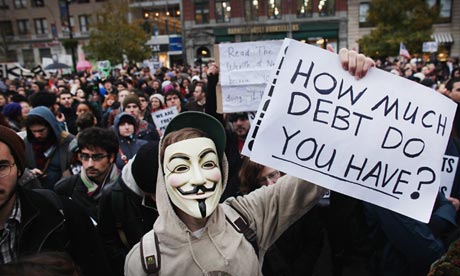
OWS activists free $15m of Americans' personal debt


Occupy Wall Street


'Our primary purpose was to spread information about the workings of this secondary debt market,' said Andrew Ross. Photograph: Spencer Platt/Getty Images

A group of Occupy Wall Street activists has bought almost $15m of Americans' personal debt over the last year as part of the Rolling Jubilee project to help people pay off their outstanding credit.
Rolling Jubilee, set up by Occupy's Strike Debt group following the street protests that swept the world in 2011, launched on 15 November 2012. The group purchases personal debt cheaply from banks before "abolishing" it, freeing individuals from their bills.


By purchasing the debt at knockdown prices the group has managed to free $14,734,569.87 of personal debt, mainly medical debt, spending only $400,000.
"We thought that the ratio would be about 20 to 1," said Andrew Ross, a member of Strike Debt and professor of social and cultural analysis at New York University. He said the team initially envisaged raising $50,000, which would have enabled it to buy $1m in debt.
"In fact we've been able to buy debt a lot more cheaply than that."
The group is able to buy debt so cheaply due to the nature of the "secondary debt market". If individuals consistently fail to pay bills from credit cards, loans, or medical insurance the bank or lender that issued the funds will eventually cut its losses by selling that debt to a third party. These sales occur for a fraction of the debt’s true values – typically for five cents on the dollar – and debt-buying companies then attempt to recoup the debt from the individual debtor and thus make a profit.
The Rolling Jubilee project was mostly conceived as a "public education project", Ross said.
"We're under no illusions that $15m is just a tiny drop in the secondary debt market. It doesn't make a dent in the amount of debt.
"Our purpose in doing this, aside from helping some people along the way – there's certainly many, many people who are very thankful that their debts are abolished – our primary purpose was to spread information about the workings of this secondary debt market."
The group has focussed on buying medical debt, and has acquired the $14.7m in three separate purchases, most recently spending $13.5m on medical debt owed by 2,693 people across 45 states and Puerto Rico, Rolling Jubilee said in a press release.
“No one should have to go into debt or bankruptcy because they get sick,” said Laura Hanna, an organiser with the group. Hanna said 62% of all personal bankruptcies have medical debt as a contributing factor.
Due to the nature of the debt market, the group is unable to specify whose debt it purchases, taking on the amounts before it discovers individuals’ identities. When Rolling Jubilee has bought the debt they send notes to their debtors “telling them they’re off the hook”, Ross said.
Ross, whose book, Creditocracy and the case for debt refusal, outlines the problems of the debt industry and calls for a “debtors’ movement” to resist credit, said the group had received letters from people whose debt they had lifted thanking them for the service. But the real victory was in spreading knowledge of the nature of the debt industry, he said.
"Very few people know how cheaply their debts have been bought by collectors. It changes the psychology of the debtor, knowing this.
“So when you get called up by the debt collector, and you're being asked to pay the full amount of your debt, you now know that the debt collector has bought your debt very, very cheaply. As cheaply as we bought it. And that gives you moral ammunition to have a different conversation with the debt collector."

Mom Blogger Raises $ to Give Away Meals on Thanksgiving


'Scary Mommy' Blogger Raises Money to Give Away Thanksgiving Meals

PHOTO: Jill Smokler, creator of popular parenting blog ScaryMommy.com, which is giving away $50 Thanksgiving gift cards to families, is pictured with her children.
When a popular "mommy blogger" noticed a number of her 7 million monthly readers saying they were struggling to put food on the table, she thought she would try to give a helping hand by providing gift cards to purchase Thanksgiving meal ingredients.
But after raising $116,517 in only a matter of weeks and with 2,122 families waitlisted for grocery gift cards, the Scary Mommy is becoming Santa Mommy just in time for Thanksgiving.
Jill Smokler, 36, used to be a graphic designer until she started the blog ScaryMommy.com about five and a half years ago when her youngest child was an infant.
Smokler, based in Baltimore, then became a New York Times bestselling author with her books, "Confessions of a Scary Mommy" last year and "Motherhood Comes Naturally (And Other Vicious Lies)" in April.
With an official 501(c)3 non-profit, Scary Mommy Nation, she launched an online Thanksgiving drive on Oct. 25, soliciting donations online from her readers and a number of food brands and grocery chains. Based on an estimate that the cost of Thanksgiving dinner is about $50 for 10 people,Scary Mommy is giving applicants on her website $50 gift cards to their local grocery stores so they can buy their Thanksgiving ingredients.
"My goal is to get a $50 grocery store gift card to anyone who needs one," Smokler said.
She has already raised enough funds to provide meals for 1,700 people, but she may have gotten more than she bargained for based on the tremendous need of her readers. The stories of need can be heartbreaking.
"How do you explain to your kids why they're eating cereal and ramen noodles for dinner every day while you don't eat at all?" one reader from Ohio writes.
Smokler is working diligently to match donors with applicants, while asking corporations to help offset her PayPal and shipping fees, which she says "are rapidly adding up."
She says with a smile that she "didn't quite keep that in mind when I promised that 100 percent of the donations would go directly to the families. "
She is waiting for PayPal to approve her nonprofit, which will help bring the fees down to 2.2 percent from 2.9 percent.
After the overwhelming response from applicants, she started contacting shipping companies and other firms, "basically anyone I could think of for help," she said.
"The resounding response was that the companies already had charities they were aligned with and couldn't help on an individual basis," she said.
She calls the process now "completely overwhelming, but so worth it."
She is hoping her roughly 7 million page views a month or 325,554 Twitter follows will continue their financial generosity so she can provide gift cards for everyone who needs one until Friday, when she will stop taking applications.

Wednesday, November 6, 2013

Walmart Workers Are Striking Today In Southern California

The Huffington Post
Nov 06, 2013

A group of Walmart workers went on strike in Southern California Wednesday in the first set of protests leading up to the holiday shopping season.

Activists say the protests began at about 7:30 a.m. Pacific time outside some Southern California stores, and is organized by OUR Walmart, an advocacy organization with ties to the United Food and Commercial Workers Union.
Wednesday's protests are the latest in a series of worker actions this year aimed at drawing attention to what workers say are their low wages, unpredictable hours and management retaliation.
(Story continues below tweets)
Walmart spokesman Kory Lundberg said that it's business as usual so far in the Southern California stores.
"Customers are shopping and associates are working and that's the thing we're seeing all around L.A. County," Lundberg said. "The reason they do that is because they know and they understand that Walmart provides associates with opportunities for career growth."
Last year, OUR Walmart helped coordinate strikes on Thanksgiving and Black Friday in 46 states and 100 stores across the country. The actions put a spotlight on the world's largest retailer during one of the biggest shopping periods of the year, but it wasn't enough to stop Walmart from having its best Black Friday ever, according to the company.
The protests will likely continue into Black Friday this year, if the website set up by activists to track them -- BlackFridayProtests.com -- is any indication.
Like many other major retailers, Walmart will be open on Thanksgiving this year, as some calendar quirks squeeze the holiday shopping season tighter than ever before.

Sunday, October 27, 2013

Protests Over Brazilian Oil Auction Rock Rio

As international oil companies bid for rights to explore a vast oil field off the Brazilian coast at an auction in a swanky Rio de Janeiro hotel, protesters massed outside and clashed with police. They were angry at the state selling off national assets to outside interests rather than licensing it to the country’s own companies.


Read more: http://world.time.com/2013/10/21/protests-over-brazilian-oil-auction-rock-rio/#ixzz2izsmSinq

The Campaign to Kill Killer Robots Gains Steam


The Campaign to Kill Killer Robots Gains Steam

A global movement is gaining traction in its effort to ban 'killer robots' that are able to target designated enemies on their own


A slew of reports over the last two weeks detailing cases of U.S. armed drones killing civilians signaled a new wave of outrage over the unregulated use of drones by the U.S. There was one report from the United Nations, another from Human Rights Watch, and one from Amnesty International. The uproar—and the sense that Washington has done little to make more transparent its use of drones—culminated in a debate Friday at the UN.
But a parallel movement has emerged to make sure that a different and perhaps more terrifying technology never makes it this far.
The Campaign to Stop Killer Robots is a coalition of weapons monitors and human rights groups leading an effort, formally since April, to establish an international ban on fully autonomous lethal weapons. Dubbed (by opponents) “killer robots,” it’s a technology that can kill targets (humans) without any human input. Whereas drones today have someone somewhere remotely determining where and when to fire, a fully autonomous air, land, or sea weapon could be making the decisions on its own.
It sounds like the stuff of sci-fi, but the technology is well within reach given existing weaponry. The U.S. Navy’s X-47B, a Northrop Grumman-developed drone, has taken off and landed on an aircraft carrier—one of the hardest maneuvers in aviation—entirely on its own, and it would only be a short step to add missiles to its weapons bay. In South Korea, a Samsung subsidiary designed—several years ago already—a stationary robot sentry that sits along the demilitarized zone and can identify and fire at a target on its own. It’s linked up with a human operator for now.
Some critics say giving a non-human technology the ability to decide if a human lives or dies is simply morally reprehensible—on the same level as chemical and nuclear weapons. They also say there are just too many uncertainties in the machines’ circuitry. What if a killer robot malfunctions and begins firing at random? What if it’s hacked? How quickly will the technology proliferate, to rival states and to non-state actors like extremist militants? And who exactly is held legally accountable when a killer robot attacks?
The Campaign released a statement earlier this month signed by some 272 computer science experts from 37 countries supporting a ban on development “given the limitations and unknown future risks of autonomous robot weapons technology.”
“We are concerned about the potential of robots to undermine human responsibility in decisions to use force, and to obscure accountability for the consequences,” the statement reads.
Still, the U.S. military is loath to rule out development of a new technology. Last year, days after Human Rights Watch released a report calling for a ban, the Department of Defense issued an ambiguous directive on autonomous weapons that restricts but does not rules out their use in the field for the time being. It remains the only government policy on the technology, and, unsurprisingly, few countries have formal policies on the issue. But advocates say the weapon could, down the line, in fact become a crucial tool for saving lives.
“While a preemptive ban may seem like the safest path, it is unnecessary and dangerous,” wrote law professors Matthew Waxman and Kenneth Anderson, both members of the Hoover Institution Task Force on National Security and Law. “If the goal is to reduce suffering and protect human lives, a ban may be counterproductive. It is quite possible that autonomous machine decision-making may, at least in some contexts, reduce risks to civilians by making targeting decisions more precise and firing decisions more controlled.”
Opponents point out that a preemptive weapons ban is not unprecedented. In 1995, parties to the UN’s Convention on Conventional Weapons added a protocol banning blinding lasers. Leading up to that ban, the U.S. was against it before it was for it—after considering the potential for mass proliferation, recalled Stephen Goose, the director of the arms division at HRW. The U.S. change of heart was enough to generate the necessary support.
For now, the U.S. says it doesn’t support an international ban. But representatives at the U.N. met over the potential threat of automated weapons earlier this week, and France, which chairs the next meeting of the CCW in November, has pledged to put the topic of killer robots on the agenda. The U.S. will conspicuously be there.
“It really reinforces that governments and militaries understand that this is something of real concern,” Goose said. “Them sitting down and talking about this is a very good thing.”


Read more: http://world.time.com/2013/10/25/the-campaign-to-kill-killer-robots-gains-steam/#ixzz2izrEA19r

UK universities urged to pull cash from fossil fuel giants

Anti-carbon divestment campaign targets £5bn of British funds
Money to burn: Fiddlers Ferry coal-fired power station near Liverpool.
Money to burn: Fiddlers Ferry coal-fired power station near Liverpool. Photograph: Phil Noble/Reuters
An international campaign to urge large institutions to dump fossil fuel investments reaches the UK this week, following rapid success in the US.
The year-old divestment campaign, Fossil Free, has grown even faster than similar efforts that once targeted apartheid, tobacco and arms manufacturers. It now aims to focus attention on the £5bn invested incoal, oil and gas by the endowment funds of UK universities. The move comes as financial giants such as HSBC, Deutsche Bank and Goldman Sachs are starting to take seriously the prospect that global action to reduce carbon emissions could leave two-thirds of the world's proven fossil fuel reserves unburnable and worthless.
"The divestment campaign will start politically to bankrupt the fossil fuel industry and throw into stronger relief that it is a rogue industry, committed to burning more carbon than any government on Earth thinks it would be safe to burn," said Bill McKibben, a prominent US climate campaigner and figurehead of the Fossil Free campaign. "One reason we are losing the battle against climate change – the most important challenge humans have faced – is the power of the fossil fuel industry to block change," he told the Observer. "It is the richest industry in the history of human enterprise."
The US campaign has already led to more than 40 institutions, including the city of Seattle, universities and churches, pulling out of fossil fuel investments. Addressing the political debate in the UK over rising energybills, McKibben said: "England has been burning fossil fuels since James Watt: there is no way you get to transition [to low-carbon energy] for free. But as economist Lord Nicholas Stern has said over and over again, the cost of not doing it is orders of magnitude higher than doing it."
Student divestment campaigns have sprung up at 20 UK universities, including the three with the largest investments: Cambridge, Oxford and Edinburgh. UK universities have more than £5bn – £2,000 per student – invested in fossil fuels, according to student group People & Planet and the 350.org campaign, which McKibben co-founded.
"Investing in fossil fuel companies, which harm communities and destroy the climate, is not OK," said Miriam Dobson, from People & Planet at Edinburgh University, where the campaign tour begins on Wednesday before visiting Birmingham and London.
British campaigners claimed a first victory last week, with the University of Surrey shifting funds from two unnamed fossil fuel companies into a renewable-energy-focused company.
The report also lists the research funding that companies, including Shell and BP, give universities, including £6m to Oxford and £17m to Imperial College London. "UK universities have become victims of corporate capture," said Kevin Smith from oil and gas watchdog Platform. "We are allowing public infrastructure to be used to subsidise a dangerous, outdated energy model."
A separate report found that the fossil fuel divestment campaign is growing faster than any previous one. "Stigmatisation poses a far-reaching threat to fossil fuel companies," said Ben Caldecott, a research fellow at the University of Oxford's Smith School of Enterprise and the Environment, and an author of the report. "In every case we reviewed, divestment campaigns were successful in lobbying for restrictive legislation."
The divestment campaign argues that there is also a financial reason for getting rid of fossil fuel investments, because increasing policies to cut carbon will eventually impact on the stocks' value. The landmark climate change report in September, from the Intergovernmental Panel on Climate Change, stated that agreement by the world's governments to restrict global warming to less than 2C meant keeping total future carbon emissions under 500 gigatonnes. Analysis by the International Energy Agency and the Carbon Tracker thinktank has shown this would mean that about two-thirds of the coal, oil and gas on the books of fossil fuel companies would have to remain unburned.
Carbon capture and storage technology would, if developed successfully, bury emissions equivalent to just 4% of total global reserves, according to Carbon Tracker.
With the 200 biggest fossil fuel companies spending $674bn in 2012 on finding new reserves (compared to $281bn renewable energy investment), the risk of inflating a stock market "carbon bubble" to the tune of trillions of dollars is "very big indeed", according to Stern. "The financial crisis has shown what happens when risks accumulate unnoticed," he said in April.
On Thursday, a group of 70 global investors with $3 trillion of collective assets launched the first coordinated effort to demand that the world's 40 leading fossil fuel companies, including ExxonMobil andf BHP Billiton,assess the financial risks a carbon bubble poses to their businesses.
"Companies must plan properly for the risk of falling demand to minimise the risk our clients' capital is wasted," said Craig Mackenzie, at Scottish Widows Investment Partnership, one of Europe's largest asset management companies. Storebrand, a $76bn Norwegian pension fund,divested from 19 fossil fuel companies in July, saying that the stocks would be "worthless financially" in the future.
While stock markets, including London which is heavily exposed to coal, have yet to significantly adjust company valuations, big financial players have started analysing the issue with reports in the last six months on the future risks of coal investments from Deutsche Bank, Goldman Sachs and Citi Commodities, while Morgan Stanley and Citi GPS have examined the wider energy market.
McKibben said the divestment campaign was one front in the battle against climate change, but a vital one given the role of similar tactics in previous historic changes, such as ending apartheid in South Africa. The Nobel peace prize winner Archbishop Desmond Tutu has blessed the movement, stating: "Divestment played a key role in helping liberate South Africa. The corporations understood money even when they weren't swayed by morality. Climate change is a deeply moral issue, too."

Twitter

Add to Flipboard Magazine.

Contact Form

Name

Email *

Message *